


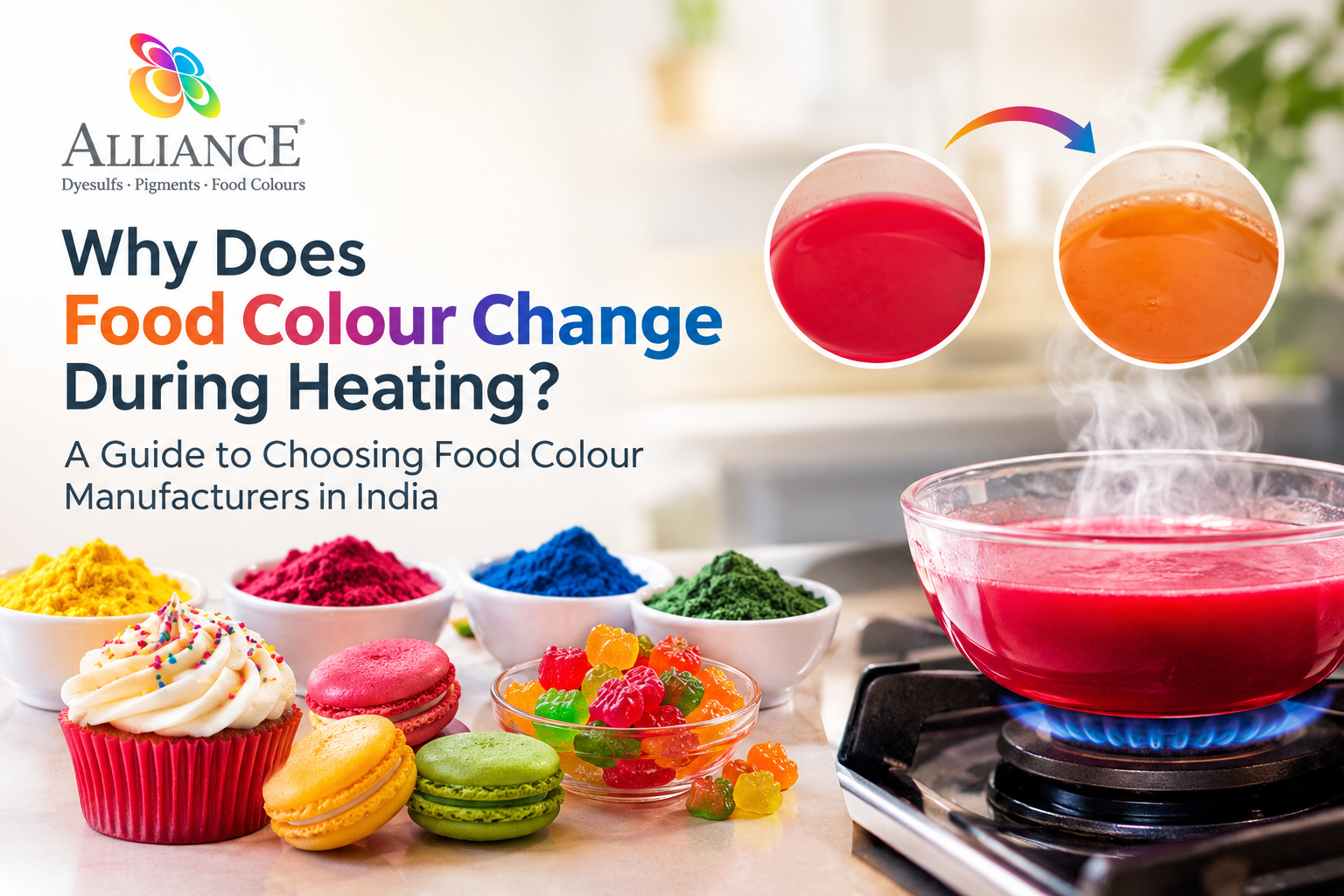
Food colour changes with heat because high temperature, pH and oxygen break apart the pigment molecules that give it its shade. Natural pigments fade fastest. Most synthetic colours hold up far better.
Anyone who has baked a red velvet cake at 180°C and pulled out something closer to brown knows the frustration. More dye won’t fix it. A better match between colour and process will, and food colour manufacturers in India who understand heat behaviour can help you find that match.
This guide covers what happens to colour in an oven, a fryer or a pressure cooker, which colours survive, and how to pick a supplier.
What you will learn: why colour shifts under heat, which colours are most stable, how to judge food colour manufacturers in India, and why Alliance Organics deserves a call.
What Causes Food Colour to Change During Heating?
Heat speeds up reactions that destroy or alter pigment molecules. Oxidation, pH shifts and sugar-protein reactions do most of the damage.
Every pigment carries its colour in a delicate chemical structure. Heat snaps it. Acidic or alkaline batters make it worse, and so does long exposure to air.
The usual suspects:
- Thermal breakdown: the pigment structure falls apart at high temperature.
- Oxidation: oxygen attacks the pigment and the shade fades or browns.
- pH shift: acid or alkali can push red toward purple, or yellow toward orange.
- Maillard browning and caramelisation: brown tones from sugars and proteins cover the added colour.
- Metal contact: traces of iron or copper can darken or dull a shade.
Which Food Colours Are Most Heat Stable?
Synthetic colours are generally the most heat stable. Many natural colours struggle at baking and frying temperatures.
The table below is a rough guide. Real results depend on your recipe.
| Colour type | Example | Heat stability | Common issue |
| Synthetic | Tartrazine, Sunset Yellow FCF | High | Few, within permitted limits |
| Synthetic | Brilliant Blue FCF | High | May shift in some acidic bases |
| Natural | Beta-carotene | Moderate | Fades by oxidation |
| Natural | Curcumin | Low to moderate | Turns reddish in alkaline batter |
| Natural | Anthocyanins | Low | Changes with pH, breaks down in heat |
| Natural | Chlorophyll | Low | Goes olive in hot, acidic food |
| Natural | Betanin (beetroot) | Low | Degrades at higher temperatures |
Natural colours aren’t a poor choice. Plenty of brands want them for clean-label reasons. They just need more care, like encapsulation or adding them after the hottest step.
How Does pH Affect Food Colour in Cooking?
pH can change a shade before heat even enters the picture. Heat then locks the change in.
Anthocyanins show this best. They look red in acidic foods and drift toward blue or grey as pH rises. Curcumin moves from yellow to red-brown in alkaline conditions.
That’s why a turmeric-yellow batter loaded with baking soda often turns out an odd orange.
Quick pH checks:
- Measure your base pH before picking a colour.
- Test the colour at that pH, not in plain water.
- Re-check after cooking, since pH can drift.
- Ask your supplier for stability data across your pH range.
How Can You Prevent Food Colour From Changing During Heating?
Match the colour to the process, control pH and cut heat exposure. Small process changes often solve big colour problems.
Most failures trace back to skipping step one below. People pick a colour first and think about the process later.
Step-by-step approach:
- Map your process: write down temperature, time and moisture.
- Pick a stable colour: match it to baking, frying or retorting.
- Adjust pH: correct the base if the colour is sensitive.
- Add colour late: put it in after the hottest stage where you can.
- Protect from air and light: use packaging that blocks both.
- Run a pilot batch: trial a small lot before scaling.
- Log the results: note shade, batch and conditions so you can repeat it.
How Do You Choose Food Colour Manufacturers in India?
Pick food colour manufacturers in India that are FSSAI-compliant, supply batch documents and offer real technical help. Price counts, but consistency counts more.
The market is crowded, and quality varies a lot. A cheap colour that fails in the oven costs you a whole batch.
Checklist for evaluating food colour manufacturers in India:
- Confirm compliance: check that each colour is permitted under FSSAI rules.
- Ask for a Certificate of Analysis: every batch should have one.
- Test technical support: can the team help with heat and pH problems?
- Request samples: trial them in your product, not in a beaker of water.
- Look at the range: good suppliers offer several shades and formats.
- Check batch consistency: strength and shade should match every time.
- Judge supply reliability: ask about lead times and capacity.
Why Choose Alliance Organics Among Food Colour Manufacturers in India?
Alliance Organics is worth approaching if you want application-focused guidance and steady supply. If your colour fades in the oven or fryer, start the conversation there.
Every supplier says its colours work. The sharper question is whether they’ll help you prove it in your own recipe.
What to ask Alliance Organics for:
- Heat and pH stability guidance for your application
- Samples to trial in your own product
- Batch-wise quality documentation
- Help choosing between synthetic and natural options
- Compliance details for your target market
Send them your process details and describe what’s going wrong. The more specific you are, the quicker the answer.
Conclusion
Food colour changes during heating because heat, pH and oxygen break down pigments. The right colour, tested in your real process, prevents most problems. Good food colour manufacturers in India make that testing far easier.
Key takeaways:
- Heat, pH and oxygen are the three main triggers of colour change.
- Synthetic colours are generally more stable; natural ones need careful formulation.
- Pick food colour manufacturers in India that offer compliance, documents and technical support.
If your colour isn’t holding up, talk to Alliance Organics. Share your process, ask for samples, and get a shade that stays true from oven to shelf.
Frequently Asked Questions
Why does food colour fade when baking?
Baking exposes colour to high heat, oxygen and often alkaline ingredients. These break down the pigment or shift its shade. A heat-stable colour and controlled pH reduce fading.
Which food colour is best for high-temperature cooking?
Synthetic colours like Tartrazine and Sunset Yellow FCF are generally the most heat-stable. They work well in baking and frying within FSSAI limits. Always trial them in your own recipe.
Are natural food colours safe for baking?
Yes, they are safe, but many lose intensity at baking temperatures. Beta-carotene holds moderately well, while anthocyanins and betanin fade fast. Encapsulated forms last longer.
How do I find reliable food colour manufacturers in India?
Look for FSSAI compliance, Certificates of Analysis, samples and technical support. Test samples in your product before a bulk order. Batch-to-batch consistency is the clearest sign of a dependable supplier.
Does pH change food colour?
Yes. Many colours change shade when acidity changes, and heat can make the shift stronger. Anthocyanins and curcumin are the most sensitive.
Can food colour manufacturers in India customise shades?
Many can, depending on the colour type and your application. Share your target shade, process and pH. A good manufacturer will run trials and adjust the blend.